
Ways And Means For Lung Cancer Treatment
Lung cancer (bronchogenic carcinoma) is the invasion of the tissue in lung cells. There are two types of lung cancer – small cell (SCLC) and non-small cell (NSCLC). Both types of cancers grow and spread differently, implying that both need different Lung Cancer Treatment.
SCLC makes up about 20% all of lung cancers. They are aggressive, rapid growing and are often (more than 90% of the time) caused by the use of tobacco (about 1% are not related).
The stages of a cancer describe whether the cancer is confined to the chest or has spread to other parts of the body, particularly in SCLC. It also takes into consideration the size as well as its presence in the lymph nodes or in other organs.
The stage determines the Lung Cancer Treatment and is critical in estimating the prognosis of the patient. This determination, in addition to several other types of testing – lab work (blood chemistry), X-rays, CT, or MRI scans will determine the direction of treatment. Any abnormal blood work could signal the presence of cancer spreading into the bone or liver.
The prevailing bronchogenic carcinoma medication options are surgical removal, chemo, or radiation therapy, and/or a combination of any or all may be prescribed to enhance the effects of one another. For example, chemo and/or radiotherapy is given after surgery to make sure that all cancerous cells are killed.
Surgery is generally performed for cancer that has not spread beyond the lung, or for NSCLC. Though 20-35% of all cancers can be removed through surgery, they do not always result in a cure. Surgery is performed with SCLC in very rare cases as these tumors do not remain localized.
Risks of surgery as Lung Cancer Treatment include breathing difficulties and/or shortness of breath, weakness, and pain. In some cases, there could be unusual bleeding and/or infection.
Radiation therapy is used for both NSCLC and SCLC as a cancer treatment. It uses high-energy X-rays to kill cancerous cells and can be used as the main treatment or in conjunction with other treatments. Radiation is a good alternative for those bronchogenic carcinoma patients who do not want surgery, or if the cancer has spread to an inoperable area of the body.
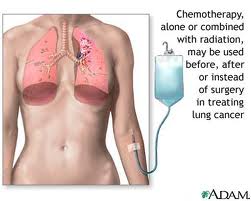
Chemotherapy, one of the Lung Cancer Treatment options is used for both types of lung cancer. It is the administration of drugs that radically stops the growth of cancerous cells, either by killing or preventing them from dividing. Chemotherapy can also, be given alone, with surgery, or with radiotherapy. It is the treatment most often used for most SCLC, since with this type of cancer there has been spreading. Only about 50% of people who have SCLC survive more than a few months without chemotherapy. Though it is not particularly effective as a cure in cases of NSCLC, it can prolong survival in cancers that have already spread.